

May 18, 2026 (updated May 22, 2026)
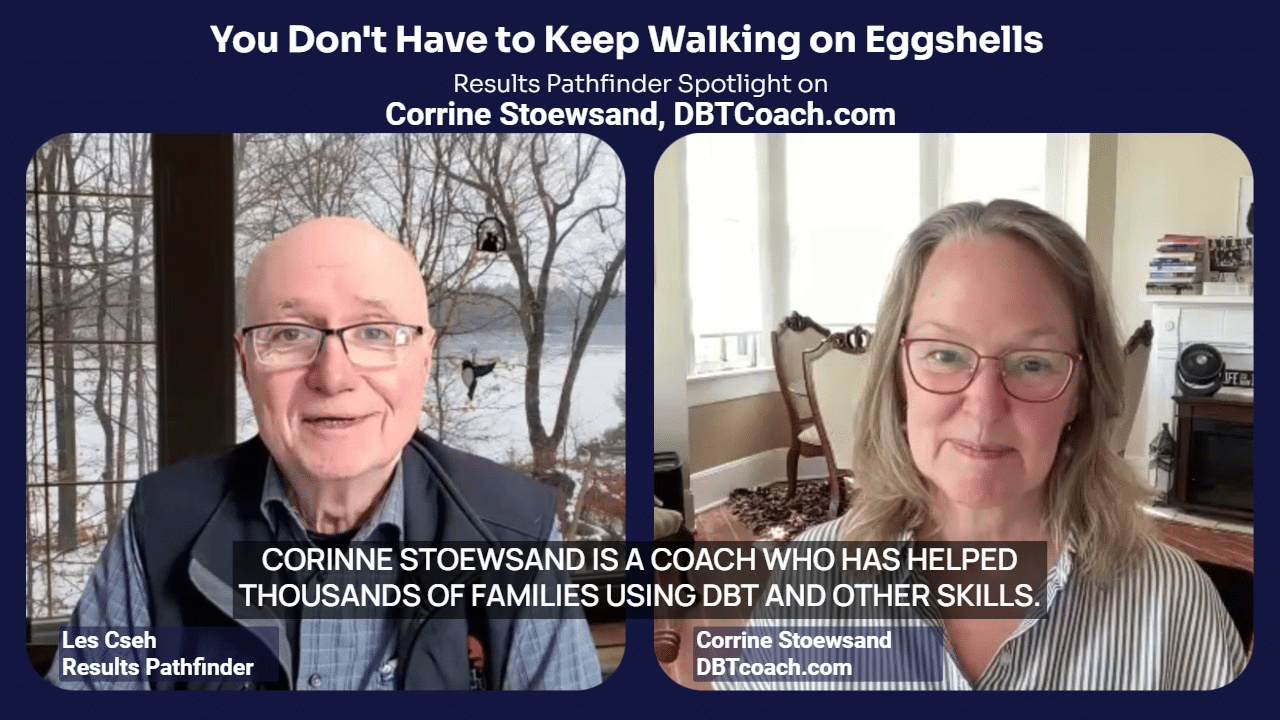
🔦 Results Pathfinder Spotlight on Corrine Stoewsand, DBTcoach.com
Usually, our spotlight feature articles are about how solopreneurs, small business owners and experts in marketing and tech grow their businesses.
In this article, I am spotlighting someone who has made a huge impact on my life and thousands of others.
Corrine Stoewsand is a coach who helps families and loved ones find their footing when someone they love has Borderline Personality Disorder (BPD) or similar conditions, and everything feels like it is falling apart.
I recently interviewed her, and am excited to share the video (later in this article) and this article about Corrine and her work.
When Tiptoeing Around Someone You Love Becomes a Way of Life
Most of us have had to tiptoe through at least a few conversations in our lives. A tense family dinner. A coworker who takes everything personally. A friend going through a rough patch.
But when someone close to you is extremely emotionally sensitive and reactive, or suffers from Borderline Personality Disorder (BPD), tiptoeing stops being an occasional thing. It becomes a way of life.
Maybe you’ve watched someone you care about go through this. Choosing every word carefully. Replaying the last blowup. Bracing for the next one. Or maybe that someone is you.


Most people caught in this situation try harder, explain better, try to make sense of what seems senseless, avoid situations, and hope things settle down. They usually don’t. It is exhausting. Confounding. It can even turn dangerous. And some end up wondering if they are the one losing their mind. That can change when they find Corrine.
The Guide Who Helps You Find Your Way Out of the Chaos
Corrine Stoewsand has spent over 20 years working with the family members and loved ones of people with BPD or emotional dysregulation.
When someone in your life is struggling with extreme emotional sensitivity, the instinct is to get them help.
But while they are working through their own journey, or refusing to, or somewhere in between, you are still living your life alongside them. Still navigating the daily reality. Still absorbing the impact.

Corrine works with you. The parent. The partner. The sibling. The friend. The one who is exhausted and confused and desperately looking for a better way to handle what keeps happening.
As a coach and educator, she does two things that can change everything. She teaches loved ones the practical skills to navigate these relationships without making things worse. And she helps them understand what is actually happening inside the person they love, the emotional storm that drives the behavior, so that empathy becomes possible even when it feels out of reach.
The skills she teaches come from the most researched and effective approaches to emotional dysregulation and BPD available today.
You’ve Tried Everything. So Why Is Nothing Working?
The people who find Corrine are not people who give up easily.
They have read the books. They have tried the patient approach and the firm approach. They have bitten their tongue, picked their battles, apologized for things that were not their fault, and walked on eggshells so long they have forgotten what solid ground feels like.
They are parents who have watched their child spiral and blamed themselves. Partners who have restructured their entire lives around keeping the peace. Siblings, friends, adult children of someone who has always been this way, who have quietly wondered for years if something is seriously wrong, and felt guilty for thinking it.

Many have already tried to get their loved one into therapy. Some have succeeded. Many haven’t. And even those who have often find themselves back at square one, still absorbing the emotional impact, still not knowing what to say or do when things fall apart.
By the time they find Corrine, a lot of them have one thing in common: they are not sure there is anything left to try.
The Harder You Try to Fix It, the Worse It Gets. Here’s Why.
Here is the part that stops most people cold.
The things that feel most natural, reasoning, explaining, staying calm, pointing out that the reaction does not match the situation, are often the exact things that make it worse.
You try harder, find better words, bring more patience. And still it escalates.
What Corrine teaches is that this is not a failure of effort or love. It is a failure of approach. When someone is in the grip of extreme emotional distress, the part of the brain responsible for rational thought is effectively offline. Logic cannot reach them in that moment. And the attempt to reason or correct can actually feel to them like their feelings are being dismissed, which pours fuel on the fire.
This is why so many people in these relationships end up feeling like they are the problem. They are not. The normal rules just do not apply here, and nobody gave them the manual.
Turns out, there can be a way out.
What Is BPD, and Why Can DBT Make a Huge Change?

Wondering if BPD might be part of what you are dealing with? Corrine’s blog has a helpful breakdown of how BPD compares to other conditions.
Borderline Personality Disorder, or BPD, is a mental health condition where emotions hit harder, faster, and last longer than they do for most people. There is also often an intense fear of being abandoned or rejected, and a sense of self that can shift dramatically depending on the situation.
People with BPD are not trying to make your life difficult. Their emotional experience is genuinely overwhelming to them. They are not choosing this.
But living alongside it, loving someone through it, is exhausting in ways that are hard to explain to anyone who has not been there. The reactions feel like they come out of nowhere. Nothing you do seems to help. And you start to wonder if you are the problem.
You are not. You just need a different set of tools.
That is exactly what DBT was built for.
Dialectical Behavior Therapy was developed in the late 1980s by psychologist Dr. Marsha Linehan, herself no stranger to the kind of emotional suffering she set out to treat. Featured by Time magazine as one of the great scientists and visionaries who transformed our world, and the author of the memoir Building a Life Worth Living, Linehan’s work has become one of the most researched and proven approaches for BPD and emotional dysregulation.
And what sets it apart is simple: it teaches real, practical skills. Not just insight. Not just understanding. Things you can actually do.


Corrine completed intensive DBT training and later, advanced and skills training directly under Dr. Linehan and has spent over 20 years translating those skills for the people who often need them most: not the person with BPD, but the people who love them.
Beyond DBT: Mentalization, RO DBT, NVR
What Corrine brings to her community goes beyond the skills drawn from dialectical behavior therapy and the DBT principles of radical acceptance and behavioral change. She keeps a close eye on emerging research and complementary approaches, weaving in what is most relevant for families and loved ones:
- Mentalization is the ability to understand what is going on inside another person’s mind and what is driving their behavior. She teaches a 4-week Mentalization workshop and sees it as a natural next step for graduates of her DBT programs.
- Radically Open DBT (RO DBT), developed by Thomas Lynch, a student of Marsha Linehan, addresses a different profile: people who are over-controlling and emotionally rigid rather than under-regulated.
- NVR (Non-Violent Resistance), developed by Haim Omer in Israel, offers practical tools for parents dealing with entitled or entrenched behavior in adult children, a situation that overlaps significantly with BPD.
Start Here: Why Genuine Validation Is the Foundation of Everything Else
The skill Corrine teaches above all others is validation. And before you assume you already know what that means, most people don’t. Not in the way she means it.
Validation is not agreeing. It is not excusing bad behavior. It is not telling someone they are right when they are not. It is simply acknowledging that their feelings make sense given how they see the world, even if how they see the world is not how you see it.
That is a small shift in words. It is a massive shift in what happens next.
One of the key concepts Corrine teaches is finding the grain of truth. In almost any emotional reaction, no matter how extreme it seems, there is a kernel of something real underneath. When you can find that kernel and reflect it back, something changes. The person feels heard. The temperature drops. And suddenly there can be space for an actual conversation.
For me personally, it was the beginning of something I had not felt in a long time: genuine hope. And for the first time, I started to trust that my efforts could actually help rather than hurt.
🔦 Results Pathfinder Spotlight:
Highlighting small businesses, experts who help them find their way and grow,
and people making an impact on our communites.
How a Painful Personal Experience Became a 20-Year Mission
Years ago, living in New York City, Corrine found herself in a relationship with an Argentinian whose emotional reactions she could not make sense of no matter how hard she tried. Then one day she came across a book with a chapter that stopped her cold. It described exactly what she had been living. That chapter was written by Valerie Porr, a New York-based DBT educator and founder of TARA4BPD, one of the longest-standing advocacy organizations for BPD families. Corrine signed up for her workshop.
Partway through, Valerie pulled her aside and said something that would change everything: you are really good at this. You should get trained in DBT.
Corrine resisted. She already had a PhD from Columbia University in another field, a career, a life. But she went back for another round of workshops, and started volunteering. Valerie introduced her to a psychiatrist from Argentina who was coming to the US for DBT training, and Corrine began her intensive DBT training with him.
She eventually made her way to Argentina, where she became a founding member of Fundación Foro in Buenos Aires, the largest and most active DBT team in South America. There, alongside Carola Pechon, a licensed clinical psychologist, she developed and began teaching what would become the 12-week family workshop, starting in 2006.
Corrine returned to the US for more training, including directly under Dr. Linehan. Marsha had studied under a Zen Roshi and eventually earned that title herself, and that same lineage, the Diamond Sangha had a group in Argentina. Corrine began attending their weekly meditations and retreats, immersing herself in mindfulness practice for over a decade.
If you want a taste of what that looks like in practice, she leads a simple one-minute mindfulness exercise in her video conversation with me earlier in this article, and it is a good example of how practical and immediate these skills actually are.
When she eventually moved back to the US in 2020, she kept going. Today, between her years in Argentina and her work here, she has been teaching these skills to families and loved ones for over 20 years.
A Close Collaboration With the Author of Stop Walking on Eggshells
If you have spent any time in the BPD world, you have likely heard of the book Stop Walking on Eggshells by Paul T. Mason and Randi Kreger.
It has helped close to a million people make sense of what they are living with.
After reading it, many readers found their way to Randi’s online community, Moving Forward, a self-help group where people in similar situations could talk to each other.


But talking to each other only goes so far. Randi could see that many of them, especially parents, needed more structured help and was looking for a way to give it to them.
When Corrine moved back to the US from Argentina, she reached out to Randi directly. She explained what she had been doing, the 12-week family workshop, the skills-based approach, the 20 years of experience. Randi was immediately interested. She invited Corrine to run one class for the Moving Forward community. Then three. Then the full workshop.

The feedback kept coming back positive. And when Corrine decided the time had come to turn her workshop manual into a book, Randi endorsed the idea and joined in.
The result is The DBT Workbook to Stop Walking on Eggshells, co-authored by Corrine, Randi, and Carola Pechon, the Argentine colleague who helped build the workshop from the beginning.
It is also available as an audiobook, narrated by Corrine herself. Both versions are available online from Amazon and your favorite bookstore.
Ready to Stop Surviving and Start Living? Here’s How to Work With Corrine.
Whether you are just beginning to understand what you are dealing with, or you have been living it for years, Corrine meets people where they are. There is no single entry point and no pressure to jump into the deep end. Whether you are just beginning to understand what you are dealing with, or you have been living it for years, Corrine meets people where they are. There is no single entry point and no pressure to jump into the deep end.
A good first step is signing up for her email list at dbtcoach.com, where she shares regular tips, insights, and updates from the world of BPD, DBT, Mentalization, RO DBT, NVR and emotional regulation.
Her blog is also worth exploring, with a wealth of helpful information.
She also points families toward outside resources like NEA-BPD, Sashbear (based in Canada), and Randi Kreger’s Moving Forward community, all offering additional support and information at no cost.
When you are ready to go deeper, there are a few ways to work with her:
The 12-Week Family Workshop is the heart of her work. It is where the skills are taught, practiced, and brought to life through group discussion and real situations. Available online.
One-on-One Coaching for those who want personalized guidance tailored to their specific relationship and situation.
If you prefer to learn at your own pace, her books are a great place to start. The DBT Workbook to Stop Walking on Eggshells, co-authored with Randi Kreger and Carola Pechon, brings the workshop skills into a practical, self-guided format and is also available as an audiobook narrated by Corrine herself.
And Genuine Validation, her earlier book on compassionate communication, is available in print and on Audible.
Wiser Minds is her subscription community for graduates of the 12-week workshop, offering ongoing support, continued skills practice, and a place to keep building on what they have learned.
Everything starts at dbtcoach.com.

🔦 Results Pathfinder Spotlight:
Highlighting small businesses, experts who help them find their way and grow,
and people making an impact on our communites.

What a beautiful article about Corrine and her work and journey. Well done Les, thank you for bringing this wonderful article to more people. DeeDee